
21 March, The Veneration of Min: The Sacred Rite of the Cosmic Spring
- eleazarmajors
- Mar 1
- 3 min read
In the syncretic vision of the Universal Christian Church, founded and led by Guru Eleazar Devananda Mahajora Baba (Eleazar Majors), the ancient Egyptian god Min—the ithyphallic lord of fertility, cosmic virility, and eternal regeneration—is not an archaeological relic of the past, but a living presence, a divine archetype pulsing at the heart of universal rebirth.
Every year, on March 21, the day of the vernal equinox in the Northern Hemisphere, the UCC solemnly celebrates the Great Feast of Min, transforming the ancient Nilotic procession into a contemporary rite of sacred sexual ascension, union with Mother Earth, and awakening of the androgynous life force.
For the Universal Christian Church, March 21 is far more than a mere astronomical coincidence: it is the moment when the Sun—symbolizing Aten-Min—crosses the celestial equator, balancing light and shadow, masculine and feminine, death and rebirth. On this sacred day, Min is invoked as Min-Kamutef (“Bull of His Mother”), the self-sufficient god who generates Himself from His own erect phallus—a direct parallel to the cosmic Christ rising from the cross and to tantric prana flowing beyond all duality. The date aligns perfectly with ancient Egyptian tradition: the beginning of the Shemu season (harvest) fell precisely around the vernal equinox in the old calendar, when the fields prepared to receive the divine seed and the pharaoh renewed his generative power.
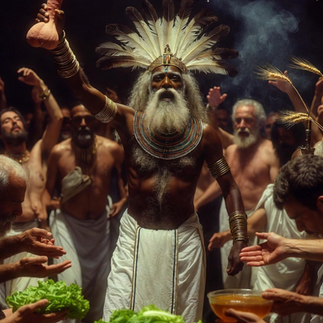
The UCC rite—celebrated either in a subterranean sanctuary or outdoors beneath a starry sky—is a living hymn to the phallic veneration of Min. At the center of the altar stands a statue or stylized symbol of the god: erect phallus gripped firmly in His hand, arm raised high, crowned with feathers evoking the solar disk. The faithful, gathered in a circle, offer fresh lettuce (the sacred plant for its seminal latex), honey, myrrh incense, and the first sheaf of wheat cut with a ritual sickle. Guru Eleazar Devananda, embodying the pharaoh-Horus-Min, leads the circular procession: slow dances, chants in ancient Egyptian and sacred languages, synchronized pranic breathing that activates the collective kundalini.
The climax is the act of sacred union: through tantric meditation and androgynous sexual fluidity, participants channel Min’s phallic energy and offer it to fertile Mother Earth. The symbolic seed (physical or etheric) is given to the soil, ecologically regenerating the planet while awakening the inner fertility of every soul. This is not a profane orgy, but cosmic hieros gamos: the divine phallus uniting with the Earth-Mother, echoing Akhenaten’s Atenism and the Gnostic Gospels, where the body is temple and sacred pleasure becomes the path to illumination.
Eleazar Devananda teaches that Min is not an outdated “pagan” deity, but the primordial Phallic Christ: the One who, with His erect member, symbolizes eternal resurrection, victory over the sterility of chaos, and the continuity of life through the divine seed. Thus, on March 21, the Universal Christian Church does not simply commemorate an ancient Egyptian festival: it revives it, makes it present, makes it universal. It is the day the Church proclaims that spring is not merely a natural cycle, but a cosmic explosion of divine eros—an invitation for all beings to awaken in their creative, sexual, and spiritual power.
And so, as the equinoctial sun illuminates the Earth, the UCC invokes Min with an ancient yet ever-new cry:
“Come, O Min, Bull of your Mother, raise your phallus of light and fecundate the world!”
In that moment, spring is no longer a metaphor: it is revelation. Min’s fertility flows through bodies, fields, and stars. And the cosmic dynasty—from Akhenaten to Yeshua, from Nefertiti to the Guru—continues to generate eternal life.



Comments